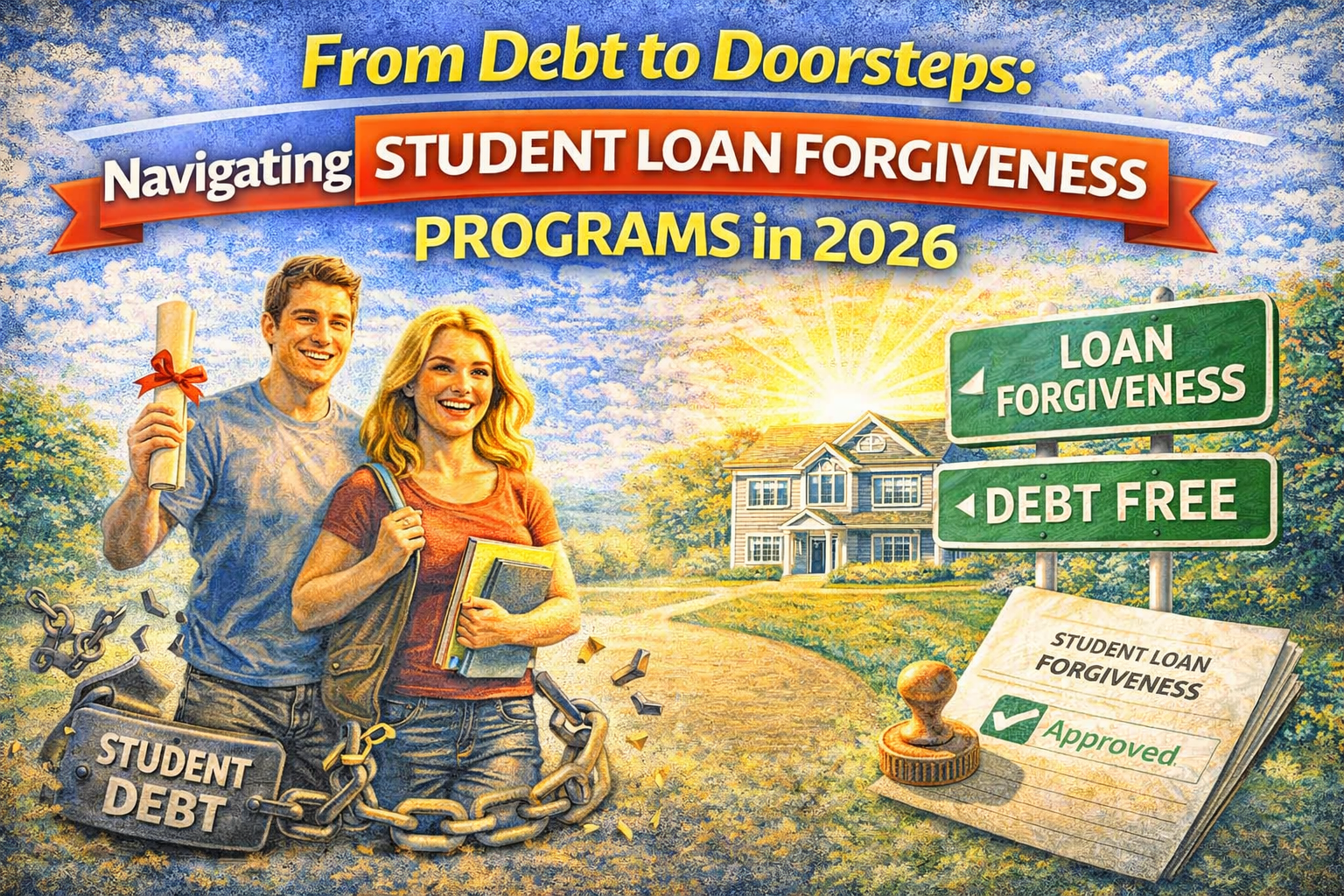
Tired of debt blocking your homeownership dreams? Discover the top Student Loan Forgiveness Programs in 2026 and how they can help you qualify for a mortgage.
Table of Contents
I was grabbing lunch in Surat yesterday with a young architect who has been trying to break into the local residential property market for three years. He has a great salary and a solid career path, but every time he sits down with a lender, his student debt hangs over the conversation like a dark cloud. “I feel like I’m paying for a house I don’t live in,” he told me, gesturing to his monthly loan statement. It is a frustration I hear from nearly every first-time buyer I meet lately.
The reality is that your debt-to-income ratio is the ultimate gatekeeper in real estate. When you are carrying six figures of educational debt, your borrowing power for a home loan shrinks significantly. However, as we move through 2026, the landscape of Student Loan Forgiveness Programs has shifted in a way that is finally offering some breathing room.
Understanding these Student Loan Forgiveness Programs isn’t just about clearing your balance; it’s about unlocking your future equity. If you can lower your monthly debt obligation through a federal or state-sponsored program, you suddenly become a much more attractive candidate for a competitive mortgage. Let’s take a real-world look at the options that are actually moving the needle for homeowners right now.
The 2026 Landscape of Public Service Forgiveness
The Public Service Loan Forgiveness (PSLF) remains the heavyweight champion of Student Loan Forgiveness Programs. If you work for a government agency or a non-profit, this is your golden ticket. In 2026, the process has become much more streamlined than the bureaucratic nightmare it used to be.
The beauty of PSLF is that after 120 qualifying monthly payments, the remaining balance is wiped out entirely. For a real estate agent or a boutique broker working in a public capacity, this can effectively double your housing budget overnight. When the lender sees that your “lumpy” debt has a definitive end date—or better yet, has been discharged—they are much more likely to approve you for that luxury listing you’ve been eyeing.
Income-Driven Repayment: The Real Estate Professional’s Secret
Not everyone works for a non-profit, but almost everyone can benefit from Income-Driven Repayment (IDR) plans. These are essential Student Loan Forgiveness Programs because they tie your payment directly to your discretionary income. If you have a slow month in the real estate market with fewer closings, your loan payment drops accordingly.
After 20 to 25 years of payments under an IDR plan, the remaining balance is forgiven. While that feels like a long time, the immediate benefit is the lowered monthly payment. Lenders look at your current monthly liabilities when calculating your mortgage eligibility. By utilizing these Student Loan Forgiveness Programs, you are effectively lowering your DTI (Debt-to-Income) ratio, allowing you to qualify for a better interest rate on a home loan.
State-Level Incentives for Homebuyers
In 2026, we are seeing a fascinating trend where individual states are creating their own Student Loan Forgiveness Programs specifically to attract young professionals to their local housing markets. Some states will actually pay off a portion of your student debt if you agree to buy a residential property in a specific “growth zone.”
These are “win-win” scenarios. The state gets a new taxpayer and a committed resident, and you get a massive chunk of debt removed from your credit report. If you are looking at investment properties in burgeoning neighborhoods, check with your local housing authority. You might find that your state offers Student Loan Forgiveness Programs that act almost like a hidden down payment assistance grant.
As noted by the National Association of Realtors (NAR), the intersection of student debt and housing inventory is the most significant hurdle for the modern buyer. Staying informed about these localized programs is a vital part of your house-hunting strategy.
Tax Implications You Can’t Ignore
Here is where I have to give you a bit of a “pro-tip” that often gets buried in the fine print. Historically, many Student Loan Forgiveness Programs resulted in a “tax bomb.” The IRS viewed the forgiven amount as taxable income.
However, under current 2026 regulations, most federal Student Loan Forgiveness Programs are exempt from federal income tax through at least the end of the year. This is a massive relief. It means if you get ₹30 Lakhs forgiven, you don’t suddenly owe the government a third of that in cash the following April. This tax-free status makes these programs a true wealth-building tool rather than just a debt-shuffling exercise.
For a deeper look into the legal history of how these debt-relief structures were created to support the national economy, Wikipedia’s entry on Student loan forgiveness offers some great historical context.
Teacher and Healthcare Specific Programs
If your “day job” is in a classroom or a clinic, you have access to some of the most aggressive Student Loan Forgiveness Programs available. The Teacher Loan Forgiveness program, for instance, offers up to $17,500 in immediate relief after just five years of service in a low-income school.
In the real estate niche, we often see “Nurse-Next-Door” or “Teacher-Next-Door” programs that pair these Student Loan Forgiveness Programs with special mortgage products. By combining debt relief with a low-down-payment home loan, professionals in these fields can go from renting a cramped apartment to owning a beautiful residential property in a fraction of the time it would take through traditional saving.
Why Your Credit Score Loves Forgiveness
Every time you make progress with one of the available Student Loan Forgiveness Programs, your credit score takes notice. Your “Credit Utilization” and “Total Debt Load” are huge factors in that three-digit number.
When a large chunk of debt is discharged, your score often sees a significant bump. In the world of real estate transactions, a higher credit score translates directly to lower mortgage interest rates. Over a 30-year fixed mortgage, a slightly better score can save you more money than the original student loan was even worth. This is why I tell all my clients: don’t just ignore your student loans; manage them like a professional investor would.
As noted by the Consumer Financial Protection Bureau (CFPB), being an informed borrower is your best defense against market volatility. Understanding how Student Loan Forgiveness Programs interact with your credit report is essential for long-term financial health.
Avoiding the Scam Artists
Because there is so much talk about Student Loan Forgiveness Programs in the news, scammers are everywhere. You’ve probably seen the ads: “Guaranteed Forgiveness for a $500 Fee!”
Let me be incredibly clear: You should never have to pay a third party to apply for federal Student Loan Forgiveness Programs. The application process through StudentAid.gov is free. If a “consultant” asks for your login credentials or an upfront fee to “expedite” your forgiveness, hang up the phone. They aren’t trying to help you buy a house; they are trying to steal your identity.
FAQ Section
How do Student Loan Forgiveness Programs affect my mortgage application? Lenders look at your monthly debt-to-income (DTI) ratio. If you are enrolled in Student Loan Forgiveness Programs that lower your monthly payment, your DTI improves, which often allows you to qualify for a larger home loan amount or a better interest rate.
Is the forgiven amount taxed as income in 2026? For federal Student Loan Forgiveness Programs, the forgiven amount is currently exempt from federal income tax through the end of 2026. However, some states may still charge state income tax on that amount, so it’s vital to check with a local tax professional.
Can real estate agents qualify for PSLF? Only if they are employed by a qualifying government agency or a 501(c)(3) non-profit organization. Most agents working for private brokerages will not qualify for PSLF but can still utilize income-driven Student Loan Forgiveness Programs to manage their debt.
How long does it take for forgiveness to show on my credit report? Once you receive your official discharge letter from the Student Loan Forgiveness Programs, it usually takes 30 to 60 days for the credit bureaus to update your profile. I recommend keeping a physical copy of that letter to show your mortgage lender in case of a delay.
What if I have private student loans? Unfortunately, most federal Student Loan Forgiveness Programs only apply to Direct Loans. If you have private debt, you won’t qualify for PSLF or IDR forgiveness. You might need to look at refinancing your private debt into a lower interest rate to improve your real estate borrowing power.
Conclusion
The path to homeownership in 2026 isn’t always a straight line, especially when you are carrying the weight of past education. But the various Student Loan Forgiveness Programs available today are more than just “government handouts”—they are strategic tools that can help you rebalance your personal balance sheet.
By being proactive, staying organized with your paperwork, and understanding how debt relief impacts your mortgage eligibility, you can stop feeling like a tenant in your own life. Take the time to audit your loans today. Whether you are looking for your first residential property or your next investment, mastering the world of Student Loan Forgiveness Programs is one of the smartest real estate moves you can make.
