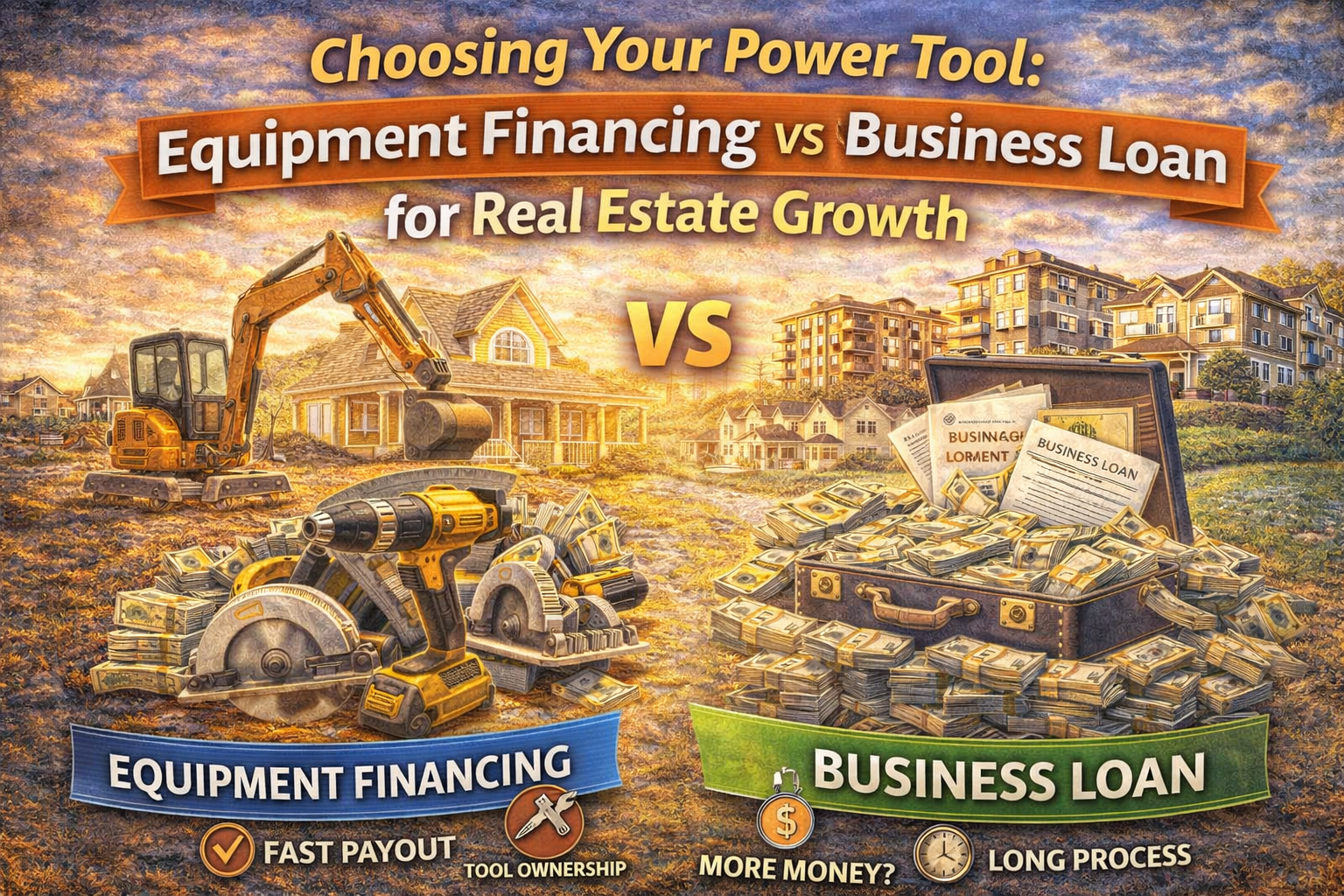
Scaling your property firm? We break down Equipment Financing vs Business Loan options to help you secure the right capital for your residential or commercial assets.
Table of Contents
I was catching up with a property management friend in Surat last week who was finally ready to scale. He’d just landed a massive contract for a new high-rise residential property, but he was hitting a logistics wall. He needed a fleet of branded maintenance vans, specialized HVAC diagnostic tools, and a high-end office setup to handle the influx of tenants. He sat there staring at two different term sheets, completely torn. “One is for the gear, and one is just a chunk of cash,” he said. “How do I know which one won’t strangle my cash flow in six months?”
It’s a fork in the road that every growing real estate or service-based firm eventually reaches. Whether you’re an agent investing in high-end staging furniture or a developer needing heavy machinery, the debate of Equipment Financing vs Business Loan is about more than just interest rates. It’s about how you want to leverage your debt and what you’re willing to put up as collateral.
Choosing the wrong one can leave you “asset rich but cash poor,” or worse, over-leveraged during a market dip. In the 2026 lending climate, the nuances between these two paths have become even more distinct. Let’s strip away the banker-speak and look at the real-world implications of Equipment Financing vs Business Loan for your growing empire.
The Targeted Approach: What is Equipment Financing?
When you look at Equipment Financing vs Business Loan options, think of equipment financing as a “self-securing” arrangement. The lender buys the specific asset you need—be it a van, a drone for property tours, or industrial cleaning gear—and the asset itself serves as the collateral.
Because the lender can just repossess the gear if you stop paying, they are often much more lenient with the approval process. For a newer brokerage or an investor with a slightly bruised credit score, this is a massive win. You don’t have to pledge your personal residential property or your retirement accounts to get the tools you need to do your job.
Furthermore, because the loan is tied to the useful life of the equipment, the terms are often very predictable. If a piece of tech is going to be obsolete in four years, the financing usually wraps up in four years. This keeps your balance sheet clean and ensures you aren’t paying for “dead assets” long after they’ve been retired.
The Versatile Path: What is a Traditional Business Loan?
The other side of the Equipment Financing vs Business Loan coin is the general-purpose business loan. This is a lump sum of capital deposited into your business bank account. You can use it for anything: hiring a new transaction coordinator, launching a massive neighborhood farming campaign, or even covering the down payment on a small office space.
The catch? Because the money isn’t tied to a specific, repossessable asset, the lender views it as higher risk. To balance that risk, they might require a personal guarantee or a lien on your other assets. When comparing Equipment Financing vs Business Loan paths, the traditional loan offers more freedom but demands more “skin in the game.”
In a volatile housing market, having a flexible pile of cash can be a lifesaver for an investor. It allows you to pivot. If a “fixer-upper” suddenly hits the market at a deep discount, your general business loan can be used to snatch it up, whereas equipment-specific funding is stuck buying a new tractor.
Equipment Financing vs Business Loan: Weighing the Interest Rates
In 2026, we’ve seen interest rates stabilize, but they aren’t exactly “cheap.” When you run the numbers on Equipment Financing vs Business Loan, you’ll often find that equipment financing carries a slightly lower interest rate.
Why? It goes back to that collateral. Lenders love having something physical they can sell to recoup their money. A general business loan is “unsecured” or “soft-secured,” meaning if your business fails, the lender has to wait in a long line to get paid. For a boutique real estate firm, saving even 1% on an interest rate over five years can be the difference between hiring a new assistant or doing all the paperwork yourself.
However, you should always look at the “total cost of capital.” Sometimes a general business loan allows you to negotiate a cash discount with an equipment supplier, which might actually make it cheaper in the long run than a specialized finance plan.
Tax Advantages and the “Section 179” Secret
In the real estate niche, we live and die by our tax deductions. This is a huge factor in the Equipment Financing vs Business Loan debate. Many countries offer specific tax incentives, like the “Section 179” deduction in the U.S., which allows you to deduct the full purchase price of qualifying equipment in the year you buy it.
If you use equipment financing, you often get the best of both worlds: you pay for the gear over time, but you take the massive tax write-off immediately. This can create a huge cash flow boost for a growing rental property business. A general business loan doesn’t always offer that same “front-loaded” tax benefit unless you spend the money on specific deductible assets immediately.
As noted by the National Association of Realtors (NAR), managing your taxable income through strategic asset acquisition is one of the primary ways successful firms maintain high liquidity during market shifts. Understanding the tax side of Equipment Financing vs Business Loan is essential for long-term growth.
Flexibility and the “Restricted Use” Trap
The biggest downside of choosing equipment financing in the Equipment Financing vs Business Loan battle is the restriction. If you borrow ₹20 Lakhs for a fleet of vehicles but then realize your biggest need is actually a new digital marketing CRM, you’re stuck. You can’t use the truck money to buy software.
A general business loan is the ultimate “pivot” tool. If the local real estate market shifts from a seller’s market to a buyer’s market, you can use that capital to hire more buyer’s agents or invest in different types of lead generation. When you choose Equipment Financing vs Business Loan, you are essentially betting on your current business model. You’re saying, “I know exactly what tools I need, and I’m ready to commit to them.”
For a deeper dive into the technicalities of how these debt structures affect your corporate credit, Wikipedia’s entry on Business Loans provides a fantastic foundation on the various types of security and covenants you might encounter.
Making the Choice: Real-Life Scenarios
I’ve worked with plenty of investors who were torn on the Equipment Financing vs Business Loan question. Here is how it usually plays out:
- Scenario A: A property manager needs three new vans. Their credit is okay, but not perfect. They choose Equipment Financing because the vans are the collateral, and the monthly payments are predictable.
- Scenario B: A real estate broker wants to open a second office. They need furniture (equipment), but they also need to pay rent, security deposits, and salaries. They choose a Business Loan because it covers the whole “expansion project,” not just the desks and chairs.
In both cases, the goal is growth. But the “how” matters. According to the Consumer Financial Protection Bureau (CFPB), being an informed borrower means understanding that every loan is a trade-off between cost, speed, and flexibility. The Equipment Financing vs Business Loan decision is no different.
FAQ Section
Which is easier to qualify for: Equipment Financing or a Business Loan? Generally, equipment financing is easier to get. Since the equipment itself serves as collateral, lenders take on less risk. Even if your business is young or your credit is “fair,” you can often secure equipment financing when a traditional business loan might be rejected.
Can I use Equipment Financing for used gear? Yes, but most lenders have “age and condition” requirements. They want to ensure the asset will last at least as long as the loan term. When comparing Equipment Financing vs Business Loan for used gear, you might find that a business loan gives you more freedom to buy from private sellers or auctions.
Does Equipment Financing require a down payment? Often, yes. Many lenders want to see you put 10% to 20% down. However, in the Equipment Financing vs Business Loan market of 2026, some specialized lenders offer “zero-down” options for established real estate firms with strong cash flow.
What happens if the equipment breaks while I’m still paying for it? You are still responsible for the payments. This is the “risk” side of the Equipment Financing vs Business Loan debate. If you have a general business loan and your equipment breaks, you might have the flexibility to use some of your remaining cash to fix it. With equipment financing, your capital is already tied up.
Which option is better for my credit score? Both can help if you make on-time payments. However, equipment financing is often viewed as “better debt” because it’s tied to a productive asset. Too many unsecured business loans can make you look “over-leveraged” to future mortgage lenders.
Conclusion
At the end of the day, the Equipment Financing vs Business Loan choice comes down to your immediate objective. If you need specific “power tools” to do your work and want to protect your other assets, equipment financing is a surgical, efficient choice. It keeps your liability focused and your tax deductions high.
However, if you need the freedom to respond to a changing real estate market, a general business loan is the flexible engine that can power your entire company, not just your tool shed. Don’t let the paperwork intimidate you. Be honest about your growth plans, run the numbers on your monthly cash flow, and choose the financing that lets you sleep at night.
