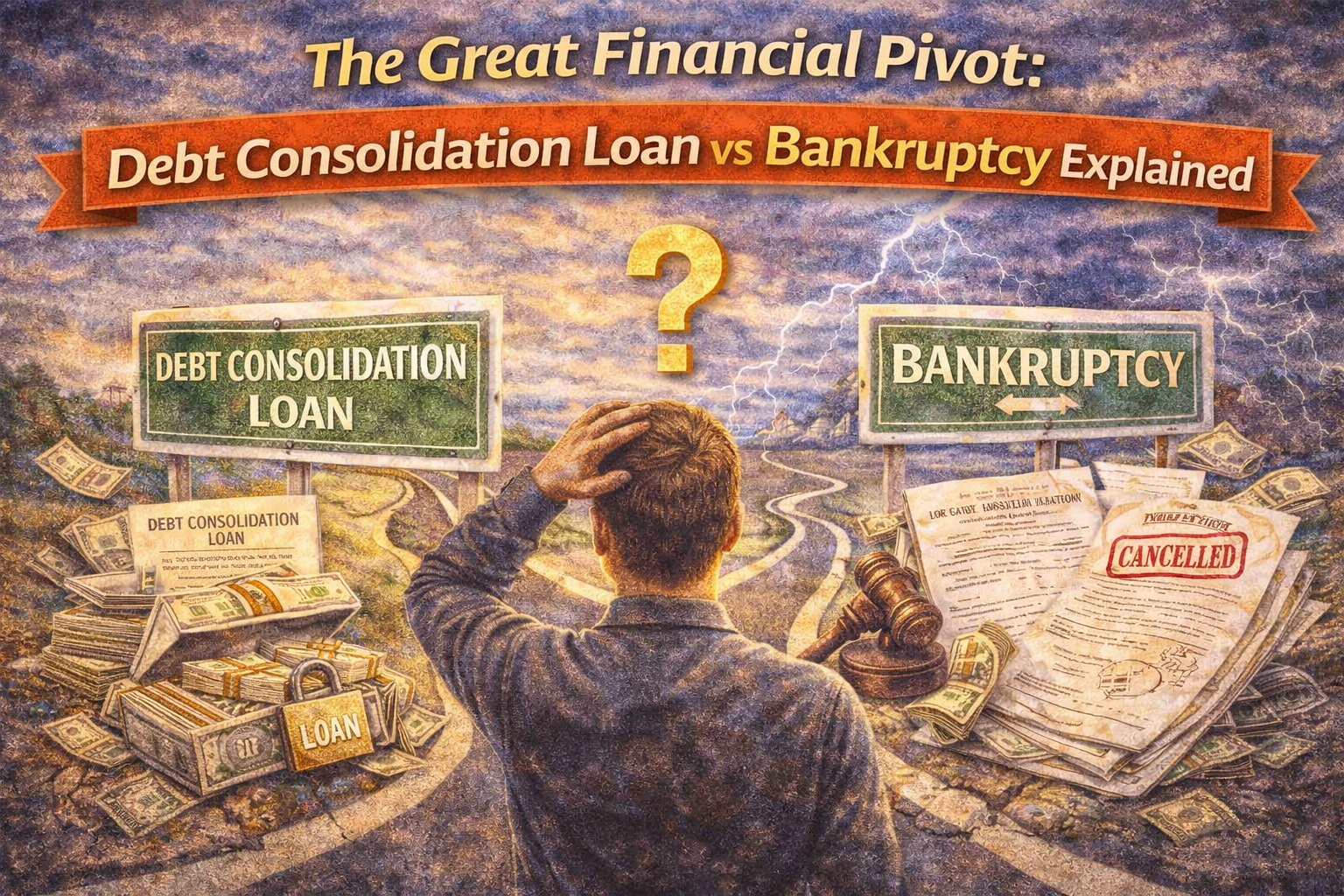
Stalling on your homeownership goals due to debt? We break down the Debt Consolidation Loan vs Bankruptcy debate to help you save your credit and your home.
Table of Contents
I was sitting in a quiet office in Surat last month, looking over a mountain of paperwork with a client who had hit a serious wall. He had been a successful real estate investor for years, but a few high-vacancy months in his rental portfolio combined with some aggressive credit card spending had left him in a tailspin. He looked at me, completely exhausted, and asked the million-dollar question: “Should I double down with a Debt Consolidation Loan vs Bankruptcy, or is it time to just throw in the towel and start over?”
It is a heavy conversation, and it’s one that is becoming more common as we navigate the economic shifts of 2026. When you are drowning in high-interest debt, every choice feels like a trap. In the real estate industry, your credit score and your debt-to-income ratio are your most valuable assets. If you lose them, you lose your ability to play the game.
Deciding between a Debt Consolidation Loan vs Bankruptcy isn’t just a math problem; it’s a strategy for your future. One path involves a disciplined reorganization of your finances, while the other is a legal “reset button” that comes with a heavy price tag for your reputation with lenders. Let’s take a human look at these two exits to see which one actually leads back to the front door of a new home.
The Proactive Path: How Debt Consolidation Works
When we talk about a Debt Consolidation Loan vs Bankruptcy, consolidation is usually the first “safe” harbor people look for. The idea is simple: you take out one large personal loan with a lower interest rate to pay off all your smaller, high-interest debts.
This is a massive win for your mental health. Instead of tracking six different due dates and worrying about fluctuating interest rates on credit cards, you have one fixed monthly payment. In the real estate niche, where cash flow is everything, this predictability allows you to actually budget for things like property taxes and homeowners insurance without the constant fear of a surprise fee.
The biggest advantage in the Debt Consolidation Loan vs Bankruptcy debate is that consolidation can actually help your credit score over time. By paying off your revolving credit card balances, you lower your credit utilization—a metric that mortgage underwriters watch like a hawk. If you can show a history of on-time payments on a consolidation loan, you’re proving to the bank that you are a responsible borrower.
The Nuclear Option: Understanding Bankruptcy
On the other side of the Debt Consolidation Loan vs Bankruptcy coin is the legal process of bankruptcy. This is a court-ordered procedure designed to give people a fresh start when their debts are truly insurmountable. It can wipe out your unsecured debts entirely (Chapter 7) or set up a court-mandated repayment plan (Chapter 13).
However, in the world of residential property, bankruptcy is a “scarlet letter” that stays on your credit report for seven to ten years. If you go this route, you can say goodbye to getting a competitive mortgage interest rate for a long time. While it provides immediate relief from creditors, the long-term impact on your ability to buy an investment property or even rent a high-end apartment can be devastating. When weighing Debt Consolidation Loan vs Bankruptcy, you have to ask yourself if you’re willing to sit on the sidelines of the housing market for the next decade.
Impact on Home Equity and Primary Residences
This is where the stakes get personal. If you own your home, the Debt Consolidation Loan vs Bankruptcy decision directly impacts your roof. In a consolidation scenario, your home is usually safe (unless you take out a home equity loan, which turns your “unsecured” debt into “secured” debt).
In bankruptcy, it gets complicated. Depending on the laws in your specific region and the amount of equity you have, you might be forced to sell your residential property to pay back your creditors. This is the ultimate “danger zone.” Many people choose the Debt Consolidation Loan vs Bankruptcy path of consolidation specifically to protect the equity they’ve spent years building. According to research often discussed by the National Association of Realtors (NAR), losing a home to bankruptcy is one of the most significant setbacks to generational wealth.
Credit Score Recovery: A Tale of Two Timelines
If you’re planning to tour luxury listings again in the future, you need to look at the recovery timeline. In the Debt Consolidation Loan vs Bankruptcy matchup, consolidation is a much faster rebuild. You might see a small dip from the initial loan inquiry, but your score can rebound within months as your debt levels drop.
Bankruptcy, however, is a “hard reset.” Your score will plummet, often by 100 points or more, and it will stay low for years. Lenders view a recent bankruptcy as a sign that you are a high-risk gamble. When you compare Debt Consolidation Loan vs Bankruptcy, consolidation is like a surgical repair, while bankruptcy is like a demolition. Both might eventually lead to a new structure, but one requires much less time to rebuild.
For a deeper look into the legal distinctions of these debt-relief paths, Wikipedia’s entry on Debt Restructuring offers an excellent foundation on how businesses and individuals manage insolvency.
The Cost of Capital: Interest Rates vs. Legal Fees
Nothing is free. When you pursue a Debt Consolidation Loan vs Bankruptcy, you’re going to pay for the privilege of a fresh start. With a consolidation loan, your cost is the interest rate. In 2026, for someone with “fair” credit, you might be looking at 12% to 18%. It’s high, but it’s much lower than the 29% you’re likely paying on credit cards.
Bankruptcy has a different cost structure. You’ll need to pay for a specialized attorney, court filing fees, and mandatory credit counseling courses. These can easily run into the thousands. When analyzing Debt Consolidation Loan vs Bankruptcy, you have to factor in whether you even have the cash on hand to afford “going broke” legally.
As noted by the Consumer Financial Protection Bureau (CFPB), being an informed borrower means reading the “Truth in Lending” disclosures. Some “debt relief” companies promise a Debt Consolidation Loan vs Bankruptcy solution that is actually a scam in disguise. Always ensure you are working with a licensed lender or a certified non-profit credit counselor.
Real Estate Investor Perspective: Protecting Your Portfolio
I’ve worked with plenty of developers who hit a rough patch. For them, the Debt Consolidation Loan vs Bankruptcy decision is a professional one. If you have multiple rental properties, a bankruptcy can trigger “acceleration clauses” in your mortgages, meaning the banks could demand the full balance of your loans immediately.
A Debt Consolidation Loan vs Bankruptcy move toward consolidation allows an investor to keep their properties while they fix their cash flow. It’s a way to maintain your reputation with commercial real estate lenders. Once you file for bankruptcy, it becomes nearly impossible to secure the “hard money” or bridge loans that are often necessary to keep a flipping business alive.
When Bankruptcy is Actually the Better Move
I’m a real estate blogger, not a magician. Sometimes, the math just doesn’t work for consolidation. If your total debt is more than half of your annual income and you have no clear path to paying it off in five years, the Debt Consolidation Loan vs Bankruptcy debate might lean toward the court system.
If you are facing a massive medical crisis or a total loss of income, a Debt Consolidation Loan vs Bankruptcy choice of consolidation might just be delaying the inevitable. Bankruptcy was created to stop the “debtor’s prison” cycle. If you are at the end of your rope, the legal reset might be the only way to eventually get back to a place where you can even think about real estate again.
FAQ Section
Will a Debt Consolidation Loan vs Bankruptcy affect my ability to rent? Yes. Most property management firms run a credit check. A consolidation loan looks like a responsible financial move. A bankruptcy can lead to an automatic rejection from high-end residential property rentals, forcing you into less desirable markets or requiring a much larger security deposit.
How soon after a Debt Consolidation Loan vs Bankruptcy can I buy a home? With a consolidation loan, you can often apply for a mortgage within 12 to 24 months, provided your score has recovered. After a bankruptcy, you typically have to wait two to four years (depending on the type of bankruptcy and the loan program) before you can even be considered for an FHA or conventional mortgage.
Which is better for my debt-to-income (DTI) ratio? In the Debt Consolidation Loan vs Bankruptcy comparison, consolidation is the clear winner for DTI. It lowers your monthly payments into one manageable chunk. Bankruptcy removes the debt, but the “event” itself makes the DTI irrelevant for most lenders for several years.
Does a Debt Consolidation Loan vs Bankruptcy stop creditor harassment? A consolidation loan stops the calls because you’ve paid off the creditors. Bankruptcy stops the calls because of an “automatic stay,” which is a legal order that prevents creditors from contacting you. Both solve the problem, but one does it through payment and the other through law.
Can I include my mortgage in a Debt Consolidation Loan vs Bankruptcy? You generally cannot include a primary mortgage in a personal consolidation loan. In bankruptcy, you can sometimes “cram down” or reorganize mortgage arrears, but your primary home loan remains a secured debt that must be dealt with separately.
Conclusion
The 2026 housing market is a place of high stakes and second chances. Whether you choose a Debt Consolidation Loan vs Bankruptcy, the goal is the same: to get your life back. If you have the income and the discipline, consolidation is almost always the better way to protect your real estate future and your credit reputation.
But if the walls are truly closing in, don’t let shame keep you from the reset you need. Take the time to talk to a professional, run the numbers on your specific residential property equity, and make the move that lets you sleep at night. Your financial story isn’t over; it’s just in a difficult chapter.
