
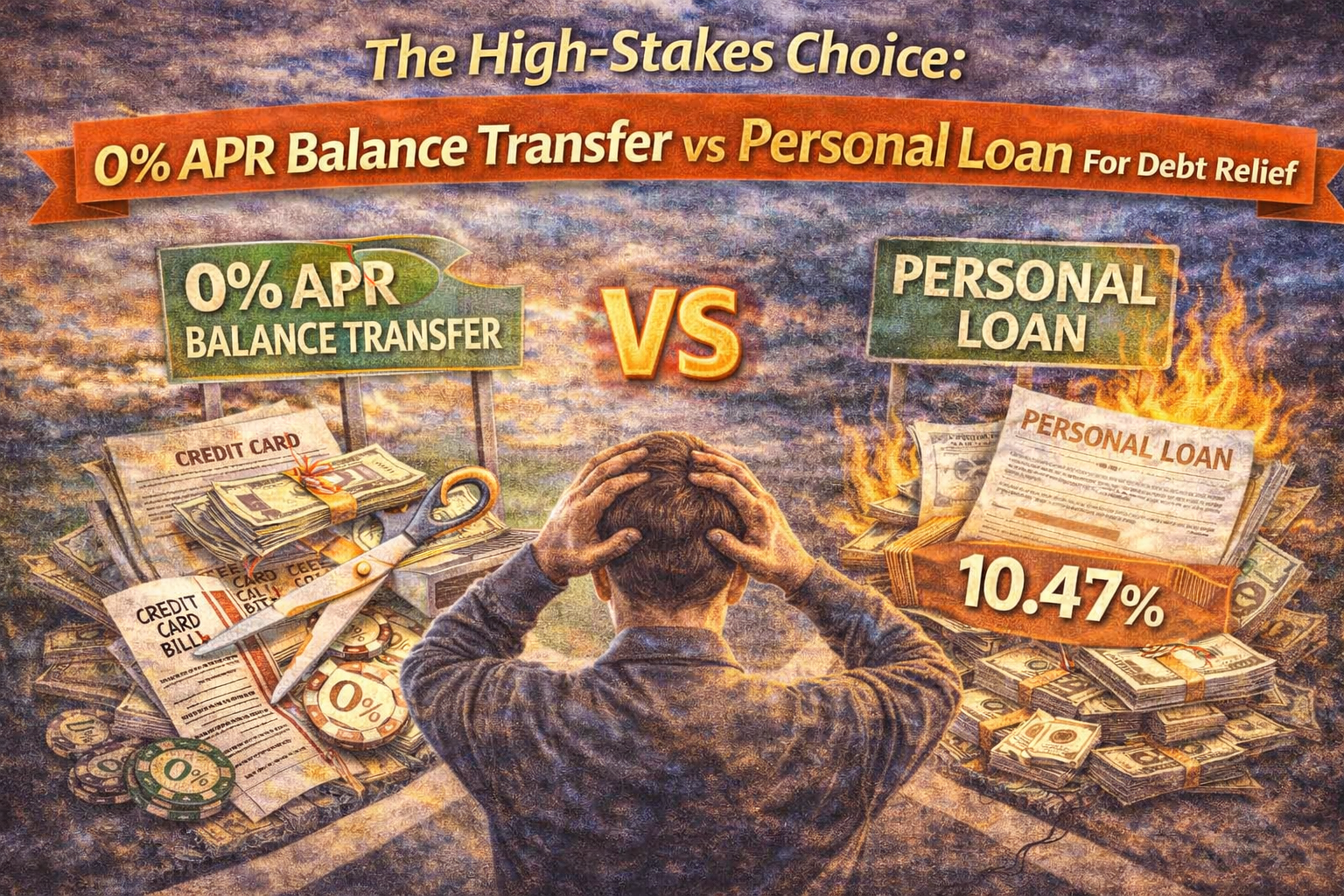
Trying to fix your credit for a mortgage? We compare 0% APR Balance Transfer vs Personal Loan options to help you clear debt and boost your buying power.
Table of Contents
I was grabbing a late lunch in Surat last Tuesday with a former client who finally decided to strike out on his own as an independent broker. He’s got the talent and the network, but his personal finances were a bit of a “fixer-upper” after a few aggressive months of marketing and staging expenses. He sat there staring at two different offers on his phone, looking completely torn. One was for a high-limit credit card with a teaser rate, and the other was a standard bank loan. “I need to clean this up before I apply for my new residential property mortgage,” he told me. “Is it better to go with the 0% APR Balance Transfer vs Personal Loan route?”
It’s a question that defines the “financial renovation” phase for many homeowners and investors. When you’re staring at high-interest credit card debt, it feels like you’re trying to build a house on shifting sand. You want to consolidate, but you don’t want to make a move that accidentally tanks your credit score right before a major real estate transaction. In the 2026 lending climate, where banks are scrutinizing every line item on your balance sheet, the choice between a 0% APR Balance Transfer vs Personal Loan is more than just a math problem—it’s a strategic play for your future equity.
Both options promise to kill high interest, but they go about it in very different ways. One is a sprint against a ticking clock, while the other is a steady marathon. Let’s strip away the banker-speak and look at which path actually leads to a set of house keys.
The Sprint: How the 0% APR Balance Transfer Works
If you have a relatively small amount of debt—say, under ₹5 Lakhs—and a rock-solid plan to pay it off in a year, the 0% APR Balance Transfer vs Personal Loan debate often leans toward the credit card. The primary draw is obvious: zero interest. For a period of 12 to 21 months, every single rupee you pay goes directly toward the principal.
However, there is a catch that many people ignore until it’s too late. Most of these cards charge a “transfer fee,” usually around 3% to 5% of the total balance. If you are moving a large sum, that fee is added to your debt immediately. Furthermore, if you don’t finish the “sprint” before the teaser period ends, the interest rate can skyrocket to 24% or higher. In the context of 0% APR Balance Transfer vs Personal Loan, the card option requires a level of discipline that many people struggle to maintain when life throws a property management emergency their way.
The Marathon: Why a Personal Loan Offers Stability
For those dealing with larger amounts of debt or a longer recovery timeline, the 0% APR Balance Transfer vs Personal Loan comparison starts to favor the installment loan. A personal loan gives you a fixed interest rate and a fixed monthly payment over three to five years. There is no ticking clock at the end of twelve months that threatens to double your interest.
For a real estate investor, this predictability is vital. You can bake that monthly payment into your cash flow projections just like property taxes or homeowners insurance. When comparing 0% APR Balance Transfer vs Personal Loan for mortgage eligibility, lenders often prefer seeing a structured installment loan rather than a maxed-out “revolving” credit card. It shows you’ve moved past the “charging” phase and into the “repayment” phase of your financial journey.
Impact on Your Credit Score and Mortgage Eligibility
This is the part where the 0% APR Balance Transfer vs Personal Loan decision gets really interesting. Your credit score is heavily influenced by “Credit Utilization.” If you open a new card and max it out with a balance transfer, your utilization on that specific card is 100%. This can actually cause your score to dip temporarily.
On the other hand, a personal loan is an “installment debt.” When you use it to pay off your credit cards, your revolving utilization drops to zero overnight. I’ve seen buyers’ scores jump by 40 points in a single month by choosing the personal loan side of the 0% APR Balance Transfer vs Personal Loan split. For someone trying to qualify for a better interest rate on a luxury listing, that score jump is worth its weight in gold.
According to data often discussed by the National Association of Realtors (NAR), debt-to-income (DTI) ratios are the primary reason mortgage applications stall. Whether you choose a 0% APR Balance Transfer vs Personal Loan, the goal is to lower that monthly obligation.
Weighing the Fees and Hidden Costs
Don’t let the “0%” label fool you. In the battle of 0% APR Balance Transfer vs Personal Loan, both have entry costs. The balance transfer fee is usually paid upfront. A personal loan, however, might have an “origination fee” deducted from the proceeds.
- Balance Transfer: You pay 3–5% of the balance today.
- Personal Loan: You pay an interest rate (perhaps 10–14%) but have much more time to breathe.
If you are a flipper who just needs a quick bridge of cash for three months while a house is on the housing market, the 0% APR Balance Transfer vs Personal Loan choice is easy: go for the 0% card. But if you are a long-term landlord trying to stabilize your personal debt, the loan is the safer foundation. For a deeper look at the technical history of these consumer debt products, Wikipedia’s entry on Debt Consolidation offers a great overview of how these tools evolved.
The “Real Estate” Mindset: Leveraging Your Liquidity
Successful property owners treat their personal finances like a business. When you look at 0% APR Balance Transfer vs Personal Loan, you are looking at your “Cost of Capital.”
If you take a 0% card and then realize you need to hire a contractor for an urgent roof repair on a rental property, you might find your credit is too “stretched” to get more funding. A personal loan keeps your credit cards empty, leaving those lines of credit available for true emergencies. In the 0% APR Balance Transfer vs Personal Loan strategy, the loan often provides better “operational flexibility” for those active in the real estate niche.
As noted by the Consumer Financial Protection Bureau (CFPB), being an informed borrower means understanding that every new account affects your ability to borrow for a home. When you decide between 0% APR Balance Transfer vs Personal Loan, make sure you aren’t applying for anything else within six months of your mortgage application.
0% APR Balance Transfer vs Personal Loan: Real-Life Scenarios
I’ve worked with plenty of clients who were torn on this. Here is how it usually breaks down:
- The “Small Fix” Scenario: An agent has ₹3 Lakhs in staging debt. They know a big commission is coming in 6 months. They choose the 0% APR Balance Transfer vs Personal Loan card route, pay it off in full when the check hits, and pay zero interest.
- The “Total Renovation” Scenario: A homeowner has ₹12 Lakhs across four cards. They need four years to pay it off. They choose the personal loan in the 0% APR Balance Transfer vs Personal Loan debate to protect themselves from rate hikes and to simplify their life into one monthly bill.
In both cases, they avoided the trap of 24% interest. They simply chose the tool that fit their specific timeline.
FAQ Section
Will a 0% APR Balance Transfer vs Personal Loan hurt my credit score? Initially, both will cause a small dip due to a “hard inquiry.” However, as you pay down the debt, your score will recover. The personal loan often provides a faster score boost because it clears your “revolving utilization” faster than a balance transfer card might.
Can I do a balance transfer onto a card I already have? Sometimes, but the best 0% APR Balance Transfer vs Personal Loan offers are usually reserved for “new customers” opening a new account. Check your current card’s “Offers” tab, but be prepared to see a higher interest rate than 0%.
Is it harder to qualify for a 0% APR Balance Transfer vs Personal Loan? Usually, yes. Credit card companies generally require “excellent” credit (720+) for their best 0% offers. Personal loan lenders can be a bit more flexible with “fair” credit, though the interest rate will be higher.
What happens if I miss a payment on a balance transfer card? The “penalty” is usually the immediate loss of your 0% rate. This is the biggest risk in the 0% APR Balance Transfer vs Personal Loan comparison. A single missed payment can trigger a 29% interest rate, wiping out all your previous savings.
Can I use a Personal Loan to pay off my mortgage? Technically, yes, but it’s rarely a good move. Mortgage interest rates are almost always lower than personal loan rates. When considering 0% APR Balance Transfer vs Personal Loan, keep the focus on high-interest consumer debt, not your home loan.
Conclusion
At the end of the day, the 0% APR Balance Transfer vs Personal Loan decision is about your personal “financial floor.” If you have the discipline to run a sprint and clear your debt in a year, the 0% card is a brilliant way to save every rupee. But if you need the security of a fixed plan while you focus on growing your real estate portfolio, the personal loan is the steady partner you need.
Don’t let debt hold your homeownership dreams hostage. Run the numbers, be honest about your spending habits, and choose the path that gets you closer to a debt-free life. Whether it’s a 0% APR Balance Transfer vs Personal Loan, the best move is the one you start today.
