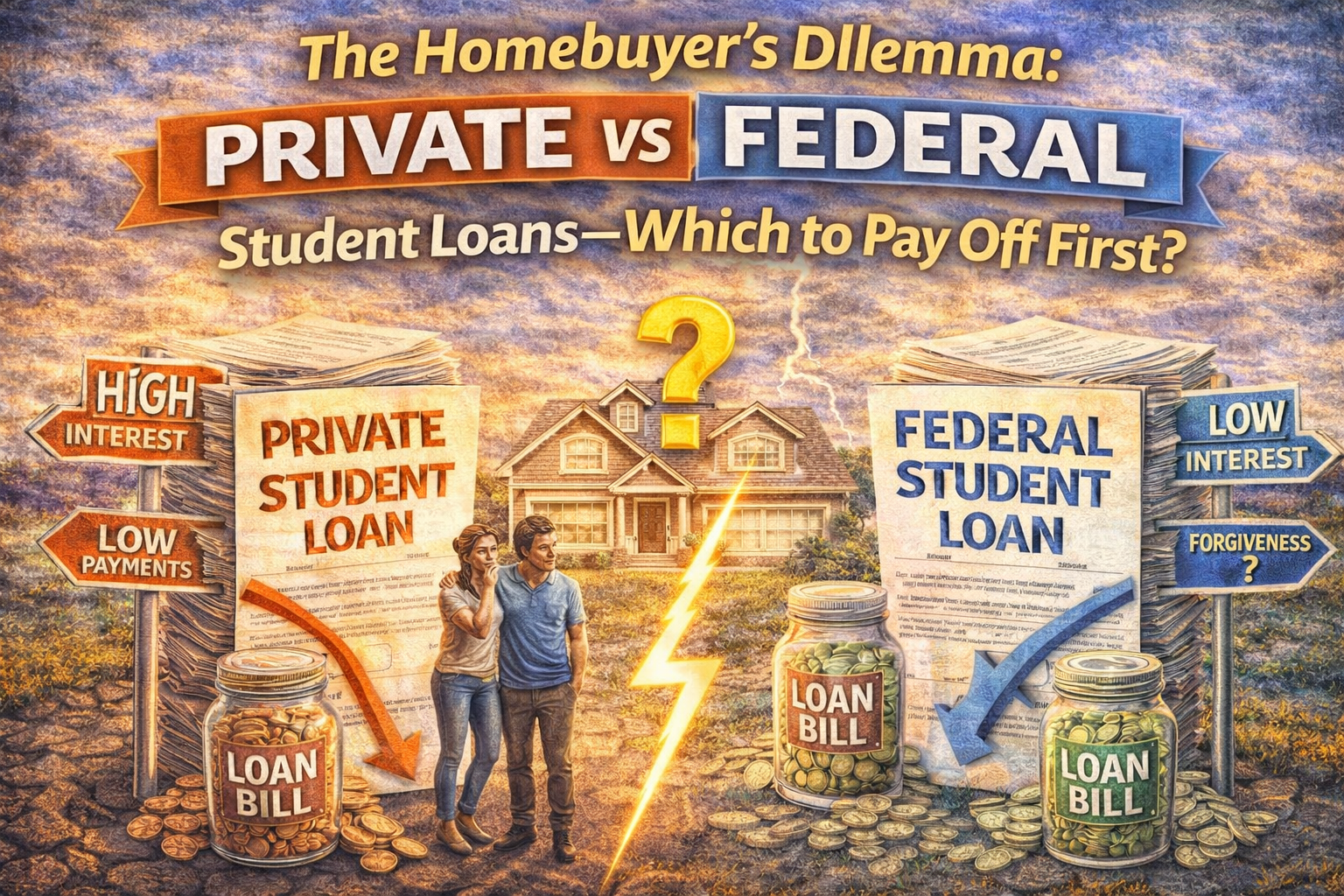
Planning to buy a home in 2026? We break down the Private vs Federal Student Loans debate so you can lower your DTI and qualify for a better mortgage rate.
Table of Contents
I was grabbing a late lunch in Surat yesterday with a young architect who is finally ready to move out of his cramped rental and into a proper residential property. He’s got a great portfolio, but his bank account tells a tale of two debts. Like many professionals in 2026, he’s juggling a mix of different educational debts and trying to figure out the winner in the Private vs Federal Student Loans battle. “I want to save for a down payment,” he told me, “but I feel like I’m throwing money into a black hole. Should I kill the private ones or the federal ones first?”
It’s a question that keeps a lot of potential homeowners up at night. In the real estate industry, we often talk about “good debt” vs “bad debt,” but student loans fall into a murky middle ground. They aren’t as “bad” as high-interest credit cards, but they aren’t as “good” as a mortgage that builds equity. When you’re staring down a house hunt, the way you handle Private vs Federal Student Loans will directly impact your debt-to-income (DTI) ratio—the metric lenders care about most.
If you’re trying to navigate this landscape, you need more than just a math equation; you need a strategy that protects your cash flow and your future roof. Let’s look at how these two types of debt behave and which one you should target first to get those house keys in your hand faster.
The Wild West: Why Private Loans Are Usually the First Target
When we look at Private vs Federal Student Loans, the private side is almost always the more aggressive beast. Private loans are issued by banks, credit unions, or online lenders. They don’t care if the housing market is in a slump or if you’ve had a bad month at work; they want their money, and they usually want it at a higher interest rate.
Most private loans carry variable interest rates that can spike without much warning. In a volatile economy, this is a massive risk. If you are trying to budget for property taxes and homeowners insurance, the last thing you need is a student loan payment that jumps by ₹5,000 overnight. By prioritizing the private side of the Private vs Federal Student Loans equation, you are effectively “de-risking” your financial life. You’re getting rid of the debt that has the fewest consumer protections.
The Safety Net: The Federal Advantage
The federal side of the Private vs Federal Student Loans debate is a different animal entirely. These loans are backed by the government, and they come with a “safety net” that private lenders simply don’t offer. We’re talking about income-driven repayment (IDR) plans, deferment, and forbearance options.
If you lose your job or decide to take a lower-paying role at a non-profit brokerage, the government can adjust your payment to $0. A private bank will not do that. Furthermore, federal loans often have fixed interest rates, providing the predictability you need when planning a long-term mortgage. When you weigh Private vs Federal Student Loans, the federal ones are much “kinder” to your monthly budget during a crisis.
How Student Debt Affects Your Mortgage Eligibility
Lenders don’t just look at your total debt; they look at your monthly obligations. This is where the Private vs Federal Student Loans choice gets interesting for homebuyers. If you have a ₹50,000 monthly payment on a private loan, that is ₹50,000 of “buying power” that is stripped away from your mortgage qualification.
By paying off the private loan first, you are physically lowering your DTI. On the federal side, you might be able to use an IDR plan to lower your reported monthly payment, even if the balance is still high. Most mortgage underwriters will use the payment listed on your credit report. So, in the Private vs Federal Student Loans strategy, many buyers choose to keep the federal loans on a low-payment plan while aggressively killing the private debt to free up as much monthly cash as possible.
According to data often discussed by the National Association of Realtors (NAR), student debt remains the single largest hurdle for first-time buyers. Understanding the nuances of Private vs Federal Student Loans is often the only way for young professionals to break into the market.
The Strategy of “Interest Rate Arbitrage”
If you have extra cash, you should always point it at the highest interest rate. In the Private vs Federal Student Loans match-up, the private loan almost always wins the “highest rate” award. Some private loans can reach 12% or 15%, while federal loans are often capped much lower.
Paying off a 12% loan is the same as getting a guaranteed 12% return on your investment. You won’t find that in a savings account or even most real estate investment trusts (REITs) right now. By focusing on the private side of the Private vs Federal Student Loans split, you are saving yourself the most money in the long run.
Why Federal Loans Might Be the “Last to Die”
As we move through 2026, the possibility of student loan forgiveness is always in the news. This is a major factor when deciding between Private vs Federal Student Loans. Private lenders will never forgive your debt out of the goodness of their hearts. However, the government has multiple programs for public service or income-based discharge.
If you pay off your federal loans early, and then the government announces a forgiveness plan six months later, that money is gone. You can’t get it back. This is why many savvy investors keep their federal debt on a slow-burn and focus every spare rupee on the private side. In the Private vs Federal Student Loans game, patience with the government often pays off.
For a deeper look into the historical context of how these different lending systems were created, Wikipedia’s entry on Student Loans offers a great breakdown of the 1965 Higher Education Act and how it shaped the modern market.
Tax Implications for Homeowners
Don’t forget about the “above-the-line” deduction for student loan interest. Whether you are looking at Private vs Federal Student Loans, you can typically deduct up to $2,500 in interest from your taxable income, provided you stay under certain income limits.
However, this deduction is a drop in the bucket compared to the mortgage interest deduction you’ll get once you buy a house. My advice? Don’t let a small tax deduction keep you in debt. The goal of comparing Private vs Federal Student Loans is to get you into a position where you can own a residential property. The equity you build in a home will far outweigh the tax perks of a student loan.
As noted by the Consumer Financial Protection Bureau (CFPB), being an informed borrower means understanding that your “Total Cost of Capital” includes the interest you pay today and the opportunities you miss tomorrow. Managing the Private vs Federal Student Loans balance correctly is about preserving your opportunity to buy.
The 2026 Housing Market Reality
We are seeing a trend where sellers are becoming more open to “concessions” to help buyers with high DTI ratios. If you’ve managed your Private vs Federal Student Loans well and shown a history of on-time payments, you might be able to get a seller to pay for your “rate buy-down.”
This only works if you’ve already cleared the most dangerous debt. If a mortgage underwriter sees a mountain of private debt with high variable rates, they might not even let you get to the negotiation table. Treating the Private vs Federal Student Loans issue as a professional priority shows the bank that you are ready for the responsibility of homeownership.
FAQ Section
Can I consolidate Private vs Federal Student Loans together? You can, but you shouldn’t. If you refinance federal loans into a private consolidation loan, you lose all the federal protections like IDR plans and forgiveness. In the Private vs Federal Student Loans debate, keeping them separate is almost always the smarter move to protect your safety net.
Will paying off student loans help my credit score? Yes, but it might be subtle. Paying off a loan reduces your total debt load, which lenders like to see. However, in the context of Private vs Federal Student Loans, the biggest benefit is the improvement to your monthly cash flow, which is what truly determines your mortgage eligibility.
Should I use my home equity to pay off student loans? This is a high-stakes move. If you use a HELOC to settle the Private vs Federal Student Loans argument, you are turning “unsecured” debt into “secured” debt. If you can’t pay the student loans, you get a bad credit score. If you can’t pay the HELOC, you lose your house. Only do this if the interest rate savings are massive and your income is rock-solid.
Which loan type is easier to get for a residential property buyer? Neither is “easy,” but federal loans are more predictable. When a lender evaluates Private vs Federal Student Loans, they prefer the fixed terms and payment caps of the federal system. Private loans with variable rates can be a “wild card” that makes underwriters nervous.
How do I find out which of my loans are private vs federal? You can check the National Student Loan Data System (NSLDS) for a full list of your federal debt. If a loan doesn’t show up there, it’s likely a private one. Keeping a clear spreadsheet of your Private vs Federal Student Loans is the first step in your payoff plan.
Conclusion
At the end of the day, your financial journey is about more than just numbers on a screen; it’s about the life you’re trying to build. Comparing Private vs Federal Student Loans is a necessary evil on the path to becoming a homeowner.
If you want my honest, human opinion: kill the private loans first. They are the most volatile and offer the least protection. Once those are gone, you’ll have the breathing room and the DTI ratio you need to finally walk through the front door of your own home. Stay disciplined, keep your eye on the housing market, and remember that every rupee you pay toward the right debt is a rupee toward your future equity.
